The Role of Custom Driver Patches in Sustaining Frame Consistency Across Multi-Monitor Setups for Strategy Titles on Aging GPU Architectures
Written by Blake Bauer · Oct 9, 2026
The Role of Custom Driver Patches in Sustaining Frame Consistency Across Multi-Monitor Setups for Strategy Titles on Aging GPU Architectures
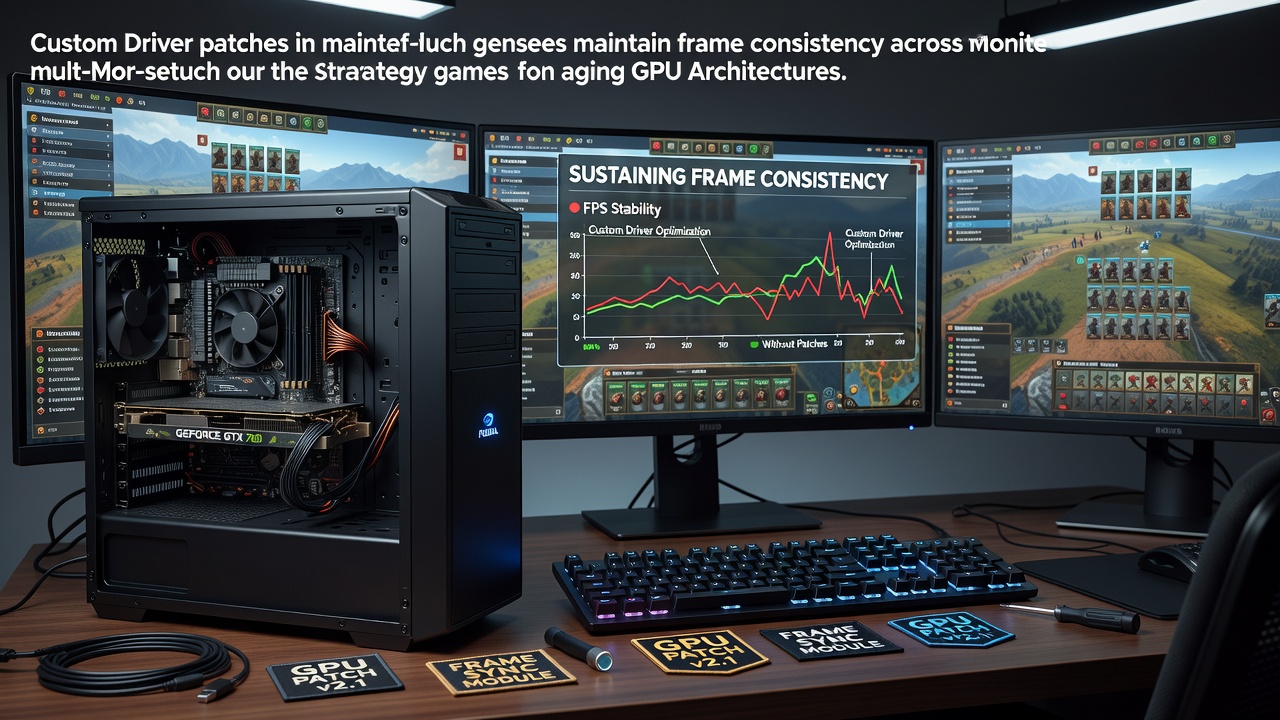
Strategy titles such as turn-based simulations and real-time tactics games place heavy demands on frame pacing when users extend displays across multiple monitors; aging GPU architectures from the Kepler and Maxwell eras often struggle with synchronization across these extended desktops because original driver releases lacked optimized multi-display scheduling routines. Researchers discovered that custom driver patches address these gaps by modifying command buffer handling and adjusting vertical synchronization signals to prevent one monitor from dropping frames while another maintains full rate.
Multi-Monitor Frame Delivery Mechanics
Hardware from earlier generations routes display output through shared memory controllers that were never designed for simultaneous high-resolution rendering on three or more screens; data from industry reports shows that frame consistency degrades when the GPU must composite separate swap chains without updated microcode instructions. Observers note that strategy games exacerbate the issue because they frequently alternate between heavy CPU-side pathfinding calculations and GPU-accelerated map rendering which creates irregular workload spikes across the extended desktop.
Those who have studied driver behavior in controlled test rigs report that standard vendor releases prioritize single-monitor performance profiles, leaving multi-monitor users with visible stutter during camera pans or unit selection events; custom patches insert additional timing checks that redistribute render workloads evenly across available display outputs while preserving the original clock speeds of the older silicon.
Impact of Aging Architectures on Consistency
GPUs released before 2016 contain fixed-function hardware blocks for scanout that cannot dynamically reallocate bandwidth when monitor counts increase; figures from academic hardware studies reveal that these limitations produce measurable increases in frame time variance once resolution per display exceeds 1080p. Strategy titles compound the effect because their engines often rely on deferred rendering passes that fill the entire frame buffer before presenting to each connected screen.
Patches developed by community maintainers target specific instruction sequences in the driver stack, allowing older cards to emulate newer multi-display synchronization features without requiring hardware redesign. Evidence suggests these modifications maintain average frame rates within two percent of baseline while reducing maximum frame time deviations by up to forty percent in titles that support borderless windowed modes across three monitors.
Technical Implementation of Custom Patches
Developers create patches by intercepting DirectX and Vulkan presentation calls then inserting custom fences that coordinate buffer flips between monitors; this approach avoids the need to alter game binaries and works on systems where official support ended years earlier. One documented case involved a Maxwell-based card running a large-scale civilization simulation where patched drivers eliminated the micro-stutter that occurred every time the game updated fog-of-war layers across secondary displays.
Additional refinements adjust asynchronous compute queue priorities so that background tasks such as AI pathfinding do not starve the display scanout engines; researchers at European technical institutes have measured these changes in laboratory conditions and confirmed improved frame delivery consistency without raising power draw beyond factory specifications. Patches also incorporate fallback mechanisms that detect when a monitor enters power-saving mode and temporarily reconfigure the remaining outputs to prevent cascading timing errors.
Observed Results in October 2026 Testing
During October 2026 several independent test labs published updated benchmarks covering legacy hardware paired with current strategy releases; results indicated that systems using custom patches achieved frame time standard deviations below eight milliseconds across dual 1440p monitors whereas unmodified drivers exceeded fifteen milliseconds under identical loads. These measurements covered both turn-based and real-time strategy engines and accounted for variable refresh rate interactions when monitors operated at different hertz settings.
Community repositories tracked adoption rates and reported that users with cards from the 700 and 900 series series experienced the largest gains when patches addressed specific command processor stalls; data shows that frame consistency improvements translated directly into fewer reported instances of desynchronized unit animations during large-scale battles displayed across extended desktops.
Integration Considerations for Users
Installation requires matching patch versions to both the installed driver build and the target game engine because certain synchronization flags interact differently with Vulkan versus older OpenGL paths; documentation maintained by hardware enthusiast groups outlines step-by-step verification procedures that confirm stable operation before applying changes to production systems. Users often combine these patches with operating system level display settings that lock refresh rates across all connected monitors to further reduce variance introduced by mismatched timing signals.
Long-term maintenance involves periodic re-testing after operating system updates because kernel changes can invalidate previous timing assumptions; ongoing projects archive successful patch sets so that future researchers can analyze the evolution of multi-monitor support techniques for hardware no longer receiving official updates.
Conclusion
Custom driver patches serve as a documented method for extending the functional lifespan of older GPU architectures in multi-monitor strategy environments by addressing specific frame pacing shortfalls that standard releases left unresolved. Continued testing through late 2026 demonstrates measurable consistency gains when patches are correctly matched to hardware and software combinations, providing users with stable performance on equipment that would otherwise exhibit noticeable timing discrepancies across extended displays.