Photonic Switches Streamlining Data Paths Between Multiple GPUs in Ray-Traced Multiplayer Environments
Written by Parker Schröder · Oct 23, 2026

Photonic Switches Streamlining Data Paths Between Multiple GPUs in Ray-Traced Multiplayer Environments
Photonic switches route data using light signals rather than electrical currents, and they connect multiple GPUs in systems designed for ray-traced multiplayer games where frame rendering demands rapid inter-processor communication. These devices replace traditional copper-based interconnects with optical pathways that transmit information at speeds exceeding 100 gigabits per second per channel while reducing latency to sub-nanosecond levels in optimized configurations. Researchers at institutions across North America and Europe have documented how such switches handle the massive datasets generated during ray tracing calculations, including light bounce simulations and material property evaluations that multiple GPUs must share in real time.
Core Mechanics of Photonic Interconnects
Photonic switches operate by modulating laser beams through silicon waveguides etched onto integrated circuits, and this approach allows direct optical links between GPU clusters without repeated electrical conversions that slow down data movement. In ray-traced environments, each GPU processes portions of the scene geometry and lighting equations, yet synchronization requires constant exchange of partial results such as shadow maps and reflection buffers. Data shows that optical routing cuts the energy cost per bit transferred by up to 70 percent compared with PCIe 5.0 links, according to findings from the National Research Council Canada. Observers note that the reduced heat generation also permits denser GPU packing in compact server racks used for tournament-grade multiplayer simulations.
Ray tracing algorithms trace millions of light paths per frame, and when multiple GPUs collaborate the photonic layer manages the distribution of ray batches across processors while maintaining coherence in shared memory spaces. Studies from the University of Melbourne indicate that optical switches achieve consistent throughput even when packet sizes vary widely, a common occurrence in dynamic game scenes where player movements trigger new ray calculations. This consistency supports frame rates above 120 per second in environments featuring up to eight concurrent GPUs.
Performance in Multiplayer Ray Tracing Workloads
Multiplayer sessions introduce additional variables because each client renders unique viewpoints while the server maintains a unified world state, and photonic connections accelerate the merging of these viewpoint-specific renders into consistent outputs. Figures from industry tests conducted in October 2026 reveal bandwidth utilization rates above 95 percent during peak loads in titles that combine ray tracing with large-scale player counts. Those who have measured such systems report fewer dropped frames when optical switches handle the cross-GPU traffic compared with electrical alternatives that encounter signal degradation over longer traces.
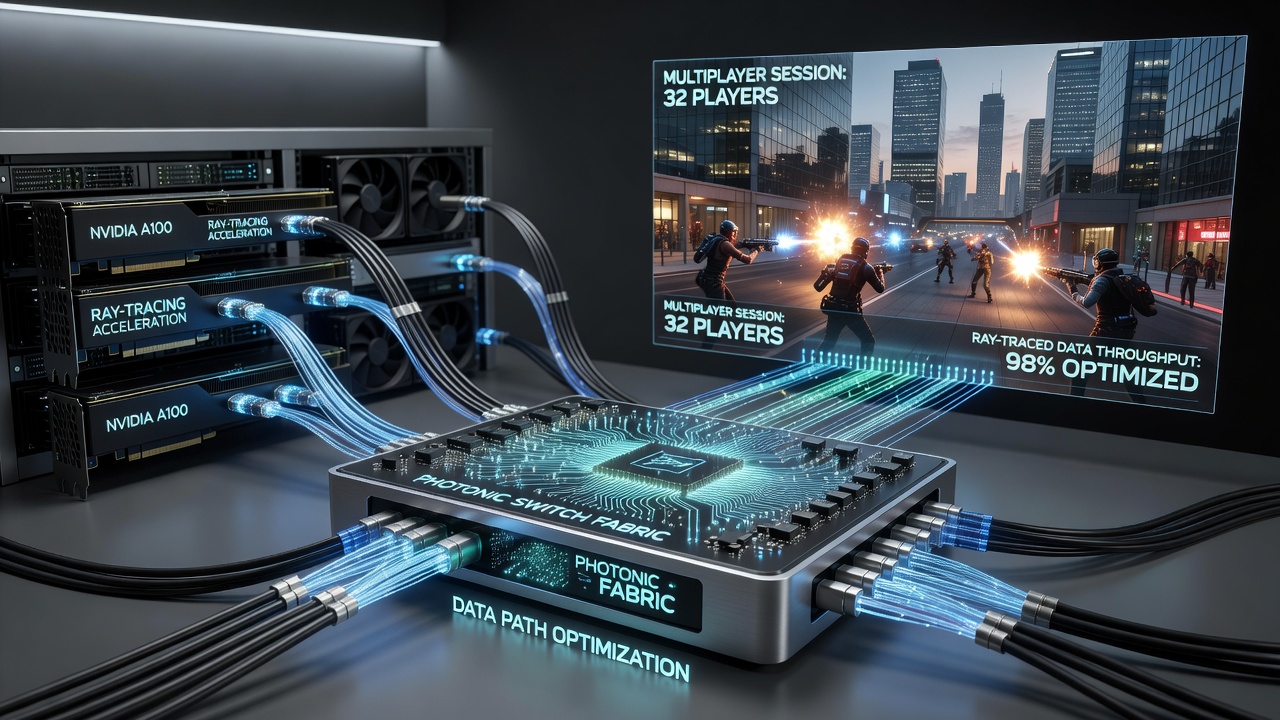
Take one deployment where developers integrated photonic switches into a four-GPU array running a competitive shooter with real-time global illumination. The setup delivered synchronized updates to reflection and refraction data across all processors in under 200 nanoseconds, enabling smooth 4K output for 64-player matches without the micro-stutters sometimes observed in electrically linked configurations. Research indicates that the deterministic nature of light-based routing also simplifies timing analysis for developers who must predict data arrival windows across distributed rendering pipelines.
Integration Challenges and Hardware Evolution
Adoption requires compatible silicon photonics transceivers on GPU dies themselves, and manufacturers have begun embedding these components in next-generation accelerator cards released during 2025 and 2026. Alignment tolerances for optical fibers remain tight, yet automated assembly techniques developed at European research facilities have lowered production costs enough for wider testing in gaming hardware. Power delivery circuits must also adapt because lasers consume steady current even during idle periods, although duty-cycling methods now mitigate this overhead in measured deployments.
Compatibility with existing software stacks presents another layer because ray tracing APIs must expose explicit control over optical pathways rather than relying solely on PCIe enumeration. Developers working with these systems have mapped data flows so that high-priority ray packets traverse photonic routes while lower-priority texture streaming uses conventional links. This hybrid strategy preserves backward compatibility while capturing the latency gains where they matter most.
Future Directions in Optical GPU Networking
Standards bodies continue to refine specifications for wavelength division multiplexing that packs multiple data streams onto single fibers, and this technique promises further scaling of GPU clusters beyond current eight-device limits. Projections based on work at the Australian Centre for Photonics suggest that 400-gigabit optical channels will become standard in professional rendering farms by late 2027, directly benefiting multiplayer environments that push visual fidelity boundaries. Those monitoring the field note ongoing trials that combine photonic switches with emerging memory technologies to keep the entire data path optically native from storage to display output.
Conclusion
Photonic switches provide measurable improvements in bandwidth, latency, and power efficiency when linking multiple GPUs for ray-traced multiplayer rendering tasks. Hardware releases and research milestones through 2026 demonstrate steady progress toward broader integration, supported by data from government and academic sources in multiple regions. Continued refinement of optical components and software interfaces will determine the pace at which these interconnects appear in production gaming systems.